Private Markets on the Rise: Adapting to a New Investment Landscape
The 2020 pandemic marked the onset of a tumultuous chain of events, beginning with the resurgence of inflation and continuing with the outbreak of kinetic warfare. Amid these challenges, many investors have held onto a quiet, unspoken hope that things will eventually return to normal. However, with each passing year, this hope seems increasingly distant.

2025 has not provided any signs of a return to the status quo. As investors face ongoing pressures from tariffs, geopolitical tensions, and long-term demographic challenges that threaten many advanced economies, it is only natural that they seek alternative solutions.
So, what strategies are the world's largest investors, such as pension funds and sovereign wealth funds, adopting to drive growth in this new landscape? This article examines how they are innovating and shifting toward private markets.
The Shift to Private Markets
Private markets, which encompass private equity, private debt, infrastructure, real estate, and venture capital, are expected to account for nearly a third of all assets under management by 2032, according to Bain & Company.[1]
Recent investor surveys, conducted by firms such as Goldman Sachs,[2] S&P Global,[3] and Ipsos,[4] indicate that investors are largely entering, increasing, or maintaining their allocations to private markets. A Barclays Private Bank survey, released on October 31st, found that 79% of investors currently active in private markets plan to increase their allocations in the coming year, while 48% of those not yet invested are considering doing so.[5]
This comes after a brief slowdown in fundraising within the private equity sector, caused by the sharp rise in borrowing rates during the 2022-2023 inflationary crisis. The increase in rates pressured valuations and made new acquisitions more costly, temporarily stalling growth. However, private equity has since adjusted to this new economic environment. In 2024, for the first time since 2015, distributions outpaced contributions, meaning that investors (Limited Partners) received more cash back from their investments than they put in for new deals.[6] This positive shift in cash flows marks a critical turning point, signaling renewed momentum for the asset class.
The Core Appeal of Private Markets
Previous articles have highlighted the key benefits of private market investing: higher returns, enhanced diversification, and lower volatility.
From the perspective of target companies, raising private capital offers more flexibility and removes the pressure of quarterly profit targets. For investors, it provides the opportunity to participate in companies from the ground up and to exert greater control over their strategies.
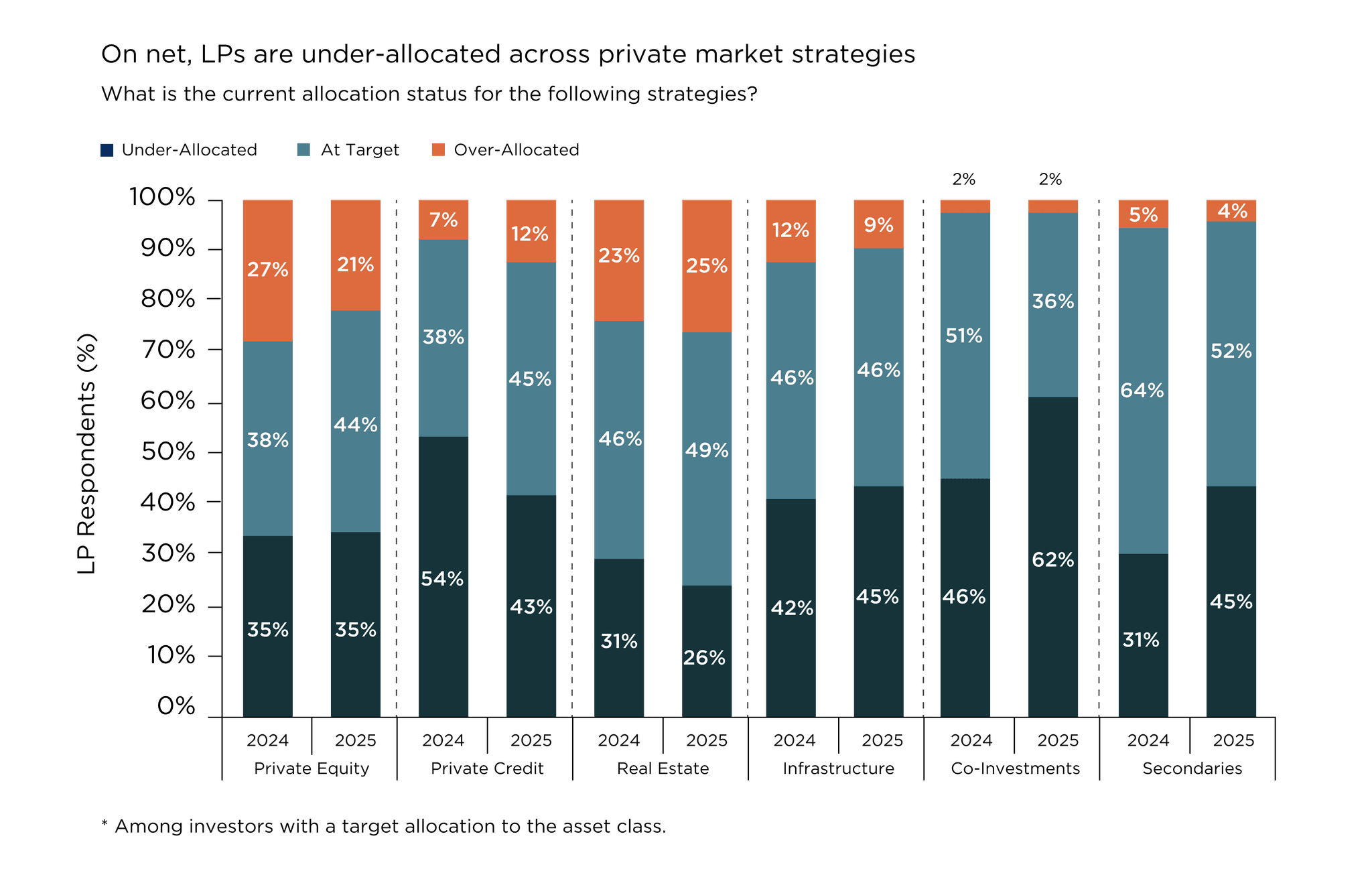
The recent lull in private equity activity has left many funds under-allocated to this asset class, signaling a steady influx of capital in the near future as investors return to the field.
A New Strategy for Private Markets
The various surveys referenced above also offer valuable insights into the factors driving the renewed ascent of private markets. Goldman Sachs highlights that operational value improvement through active ownership has become the primary focus, moving away from a reliance on purely financial engineering.
BNP Paribas also points to the growing importance of thematic investing, noting that the traditional "rising tide lifts all boats" strategy is no longer effective.[8]
Among the various asset classes, infrastructure has seen the highest rate of new commitment, with 46% of Limited Partners focusing on this sector, according to McKinsey’s 2025 Global Private Markets Report. The IFM survey further indicates that investors expect returns on Infrastructure Equity to rise to 13.4%, in line with traditional private equity returns.
The restructuring of global trade, the transition to green energy, and the AI revolution all require significant new infrastructure, whether in the form of manufacturing capacity, power generation, or transport infrastructure like airports and roads. This forthcoming wave of investment presents a rare opportunity for both growth and stability, offering predictable and resilient cash flows.
Given the strain on many government budgets, private fundraising is likely to play a critical role in financing this new wave of infrastructure development.
The Importance of Due Diligence
While the benefits of private markets may seem highly attractive, they come with their own set of challenges, particularly the need for rigorous due diligence. Financial engineering is broadly applicable across industries, but operational value enhancement is business-specific and therefore rarer.
As demand for private market investments continues to rise, an increasing number of funds will emerge, competing for capital. This will result in a more crowded field, with a widening gap between high-performing and underperforming funds.
To fully capitalize on the private market opportunity, investors must be highly selective. They need to identify fund managers with functional and sectoral expertise, backed by a proven track record of success.