Private Credit in 2026 Finding Dislocations Amid Volatility
Pressure is emerging in selected areas of private credit, while much of the market remains resilient. These differences are helping investors identify dislocations across strategies, managers and borrowers.

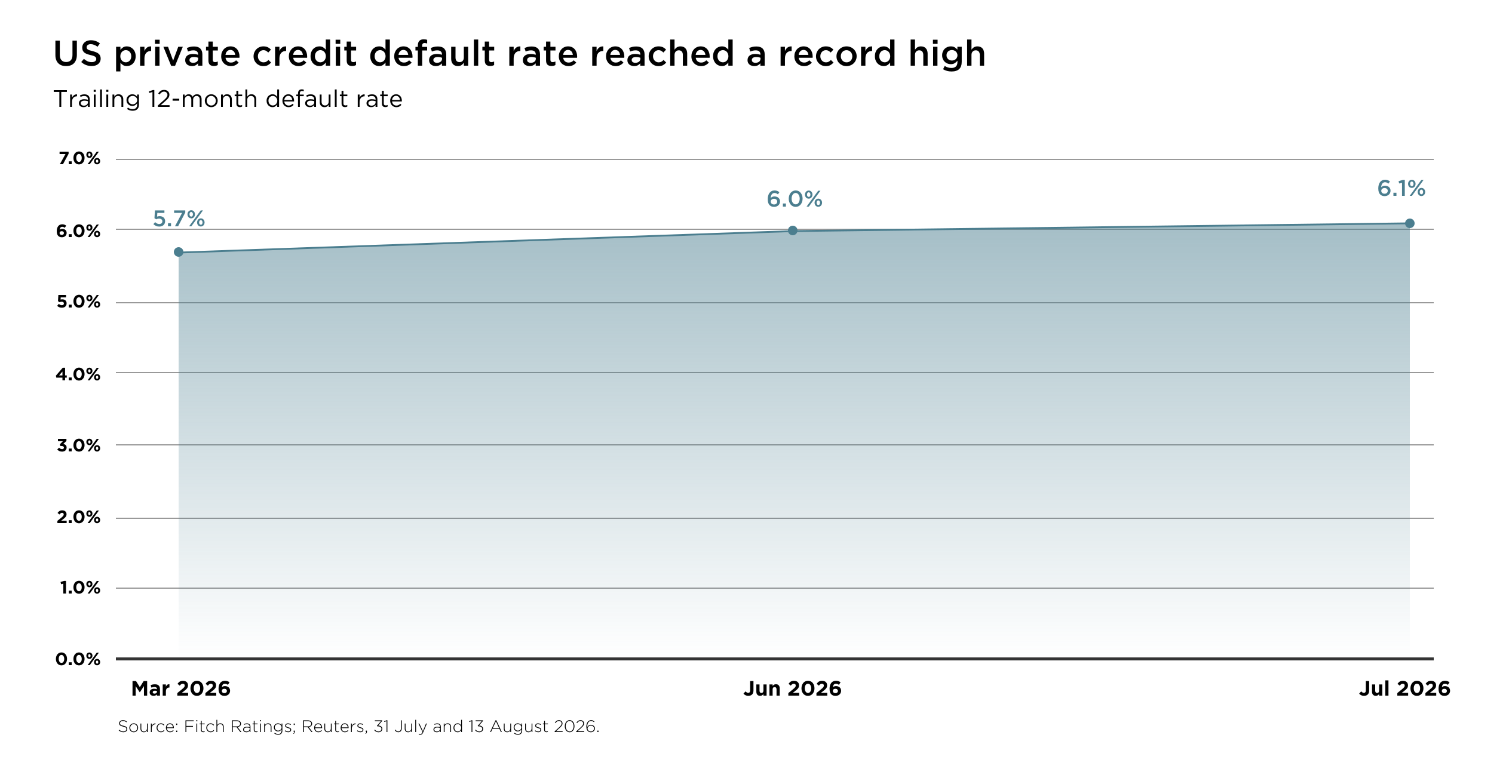
After years of strong growth, private credit is moving through a period of greater differentiation. Fitch Ratings in the US placed defaults at a record high in July 2026, several semi-liquid funds reported elevated redemption requests, and exposure to software borrowers is being reassessed as artificial intelligence changes competitive dynamics. These developments are creating pockets of volatility rather than a uniform shift across the asset class.[1]
Conditions differ substantially by sector, underwriting approach and fund structure. Leading managers have generally continued to report resilient earnings, while institutional interest in the asset class remains firm. The available evidence therefore points to concentrated stress, not broad weakness across private credit.[2]
The Federal Reserve has described private credit markets as functioning normally. In this environment, volatility can bring differences in pricing, fundamentals and risk into sharper focus. This may help selective investors identify dislocations without treating private credit as a single, uniform exposure.[3]
Pockets of pressure are emerging across sectors
Fitch's trailing 12-month US private credit default rate rose to 6.1% in July 2026 from 6.0% in June, the highest reading since the series began. Fitch recorded 32 default events involving 20 new borrowers during the second quarter. Sector results were uneven: industrials and manufacturing reached 10.4%, while healthcare stood at 9.4%.[4]
These figures deserve attention, but they do not describe every private credit strategy or manager. Funds finance different borrowers, use different levels of leverage and negotiate different contractual protections. As these differences become more visible, dislocations may emerge where market pricing and underlying fundamentals do not fully align. Careful underwriting remains essential to distinguish opportunity from uncompensated risk.
AI is creating financing demand and borrower pressure
Technology has become a larger component of direct lending. According to the Bank for International Settlements, direct-lending funds increased their exposure to artificial intelligence and information technology fourfold over five years. Together, the sectors now represent about 15% of portfolios.[5]
That exposure contains two very different credit stories. Investment in data centres and computing capacity is generating new financing requirements. At the same time, established software companies that borrowed heavily during the low-rate period may face pressure if AI weakens demand for their products or changes their competitive position.[6]
A broad technology label can therefore conceal materially different credit profiles. A loan supported by contracted infrastructure cash flows is not equivalent to credit extended to a software business facing potential revenue disruption. Looking beneath the sector label can help investors separate financing opportunities from areas where business-model risk is increasing.
Redemptions are testing fund liquidity
Several funds also faced unusually high withdrawal demand in the second quarter. Redemption requests equalled 38.1% of net asset value at one technology-focused vehicle, 18.9% at another credit fund and 16.8% at a third. Most of these vehicles repurchased shares up to roughly 5% of net asset value and carried the balance forward.[7]
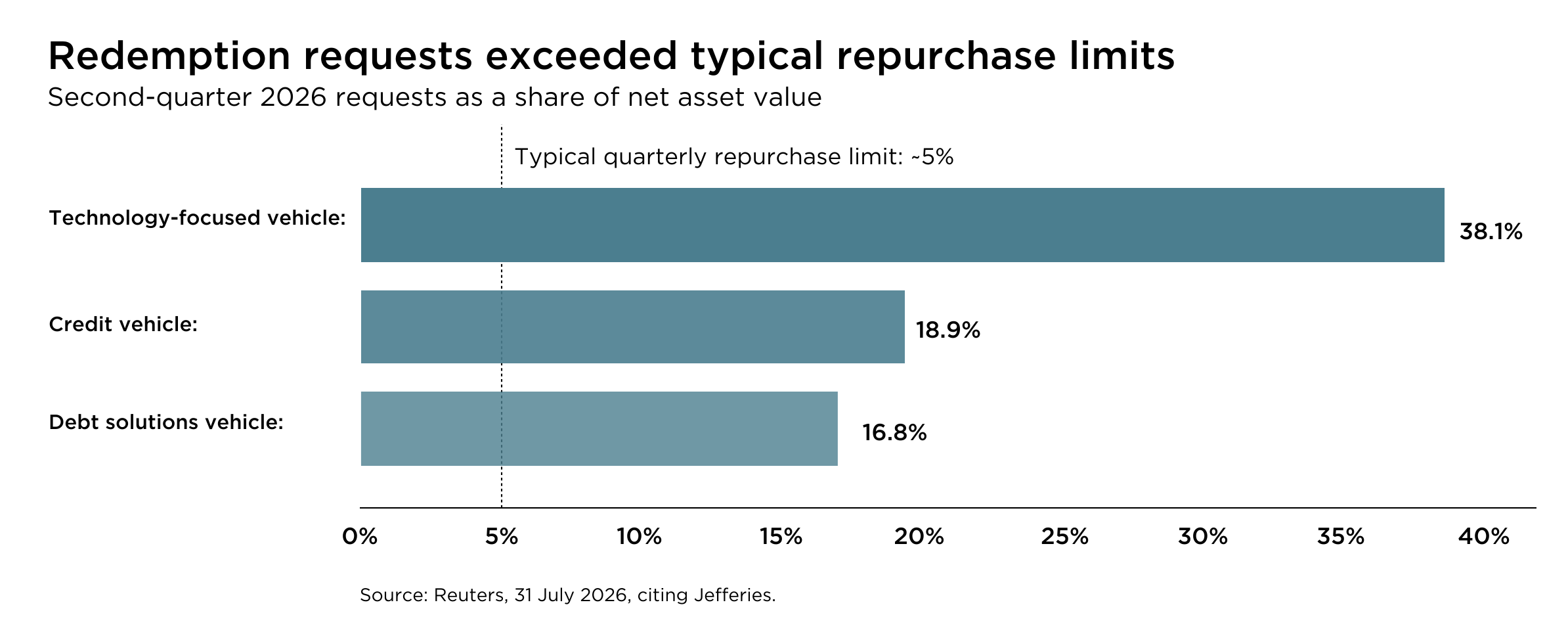
A redemption queue does not automatically indicate weak underlying investments. It does show the tension that can arise when a fund offers periodic liquidity while holding loans that may remain outstanding for years. The secondary market is increasingly helping investors manage that gap. Global private credit secondary volume reached $20.4 billion in the first half of 2026, an increase of 122% from the same period a year earlier.[8]
What could broaden the current stress
System-wide indicators remain relatively stable. Minutes from the Federal Reserve's July meeting acknowledged that second-quarter redemption requests had continued to increase, yet defaults changed little over the meeting period and credit remained available to most businesses.[9]
High leverage can leave borrowers vulnerable, but vulnerability alone does not create a systemic crisis. A wider economic shock that reduced earnings, weakened cash flow and triggered a recession would be needed to turn isolated credit problems into a broader debt event. In the absence of that trigger, current stress appears contained.
What this means for private credit allocations
Dislocations are becoming more visible amid pockets of volatility across private credit. This makes strategy selection, manager selection and portfolio construction more important. A private credit position should also be considered alongside an investor's exposure to private equity, technology, real estate and other illiquid assets. Holdings spread across several funds may still rely on the same sectors, borrowers or economic drivers.
At Petiole, we evaluate private debt as part of the wider private markets allocation. Our review considers how a manager sources and underwrites loans, the protections contained in the documentation, borrower and sector concentration, fund-level leverage, valuation policies and experience with stressed credits. We also assess whether a vehicle's liquidity terms are consistent with the investor's expected cash needs.
Where appropriate, we diversify across managers, credit strategies and vintages. Each can respond differently to the same market environment, helping reduce reliance on one underwriting approach, borrower group or part of the credit cycle.
This analysis helps determine which opportunities may be suitable, how large an allocation should be and what role it should play. Private credit can contribute income and diversify return sources, provided the position remains proportionate to the portfolio's overall concentration and capacity for illiquidity.
Current conditions do not point to broad trouble across private credit. They point to a more differentiated market in which selected sectors and fund structures face pressure while other areas remain resilient. For investors, pockets of volatility may reveal attractive dislocations, but capturing them depends on understanding the strategy, the manager and the loans beneath the asset-class label.