The Fed’s October Decision: Balancing Inflation Risks with Policy Flexibility
The Federal Reserve’s (the “Fed”) September 16 meeting marked its first interest rate increase since 2023, [1] with the committee unanimously voting to raise the target range by 25 basis points to 3.75%–4.0%. [2] The decision was significant on several fronts, reflecting continued concerns about inflation and the direction of monetary policy. This article examines the economic data underlying the decision and its implications for investors.

The September meeting
The unanimous decision to raise interest rates[3] reflected the Fed’s concerns about persistent inflation. During the press conference, Chairman Kevin Warsh emphasized that inflation had remained excessively high for an extended period. Reinforcing his position from Jackson Hole, he also indicated that broader financial conditions could hardly be characterized as restrictive.[4]
The minutes of the meeting, published on October 7, provided further insight into the committee’s assessment. Many participants expressed concern that persistently elevated energy prices could contribute to broader inflationary pressures. Several considered the prevailing policy rate to be either only mildly restrictive or not restrictive at all, consistent with Warsh’s assessment. A couple of participants also revised their estimates of the neutral interest rate upward.[5]
The Summary of Economic Projections (SEP) reinforced this more hawkish outlook, indicating expectations for higher interest rates than those projected in June.
The median projected rate for the end of 2026 increased from 3.8% to 4.1%, with 16 of the 18 participants submitting projections anticipating at least one additional rate increase during the year. The median projection for the end of 2027 also stood at 4.1%, although expectations varied. Eight participants projected rates above that level, while four anticipated lower rates.[6]
Examining the economic data
The economic indicators available to the Fed at its September meeting raised concerns about both the level and persistence of inflation. Core Personal Consumption Expenditures (PCE) inflation stood at 3.3% in July, following readings of 3.3% and 3.5% in the preceding two months.[7]
However, the Bureau of Economic Analysis (BEA) released its annual update on September 30, introducing changes to the measurement of portfolio management fees, software, and legal services within the PCE index.[8]
Following these methodological adjustments, July’s core PCE inflation was revised downward to 3.0%, with August also recording 3.0%.[9]
Labor market figures were similarly revised lower. August payroll growth was reduced from 162,000 to 133,000 jobs, while July’s initial increase of 21,000 was revised to a decline of 10,000. September employment figures showed an increase of just 29,000 jobs.[10] Together, these developments suggest that the labor market is not overheating and could remain vulnerable.
Other economic indicators, however, presented a more resilient picture. Second-quarter GDP growth was revised upward from 1.5% to 2.2%, while the personal saving rate for July increased from an initially reported 3.0% to 4.6%.[11] Neither revision points to an economy experiencing significant pressure.
It is important to note that the downward adjustment to inflation was not entirely unexpected by the Fed. According to the meeting minutes, Fed staff had already estimated August core PCE inflation at 3.2% using the BEA’s revised methodology, compared with 3.4% under the previous approach. Warsh also referred to August core PCE inflation as approximately 3.2% in his opening remarks.[12]
Nevertheless, a central concern remains unchanged. Even at the revised level of 3.0%, core PCE inflation continues to exceed the Fed’s 2% target by a full percentage point. Warsh has repeatedly made clear that allowing inflation to remain persistently above target is not an acceptable outcome.[13] This likely helps explain the Fed’s continued inclination toward a more hawkish policy stance.
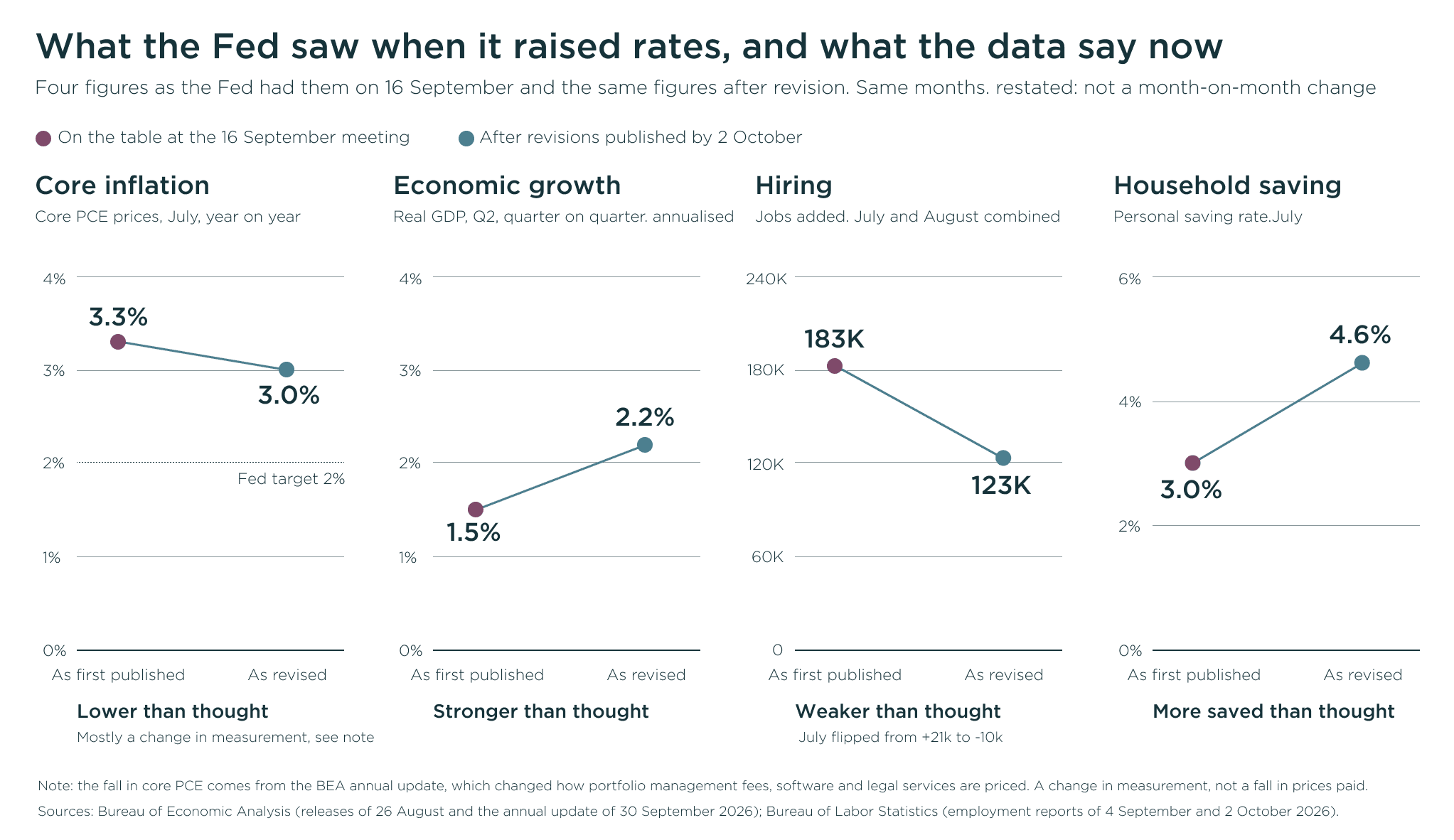
Source: Bureau of Economic Analysis; Bureau of Labor Statistics.
Conclusion
Market expectations for another interest rate increase in October climbed to approximately 70% one week after the September decision.[14] Since then, the Fed’s dot plot, revised economic indicators, and comments from officials suggesting a more gradual approach have shifted expectations for the next increase to December.[15]
The latest inflation indicator available to the committee will be September’s core Consumer Price Index (CPI), released on October 14. The annual reading reached 2.6%, exceeding the Cleveland Fed’s nowcast of 2.4%.[16][17]
Warsh has repeatedly emphasized that he does not intend to provide forward guidance on the future direction of monetary policy.[18] Nevertheless, markets continue to interpret the Fed’s projections to assess the likely path of interest rates, even though Warsh has chosen not to submit his own projections.[19]
By avoiding explicit commitments about future policy decisions, Warsh retains greater flexibility than the Fed had when relying on the characterization of inflation as transitory.[20]
Governor Christopher Waller’s October 8 remarks illustrate this approach. While recognizing that inflation remains too elevated and that further interest rate increases may be necessary, he emphasized that the timing of those increases remains flexible. Rate hikes need not occur at consecutive meetings, provided they are implemented within an acceptable timeframe.[21]
Ultimately, the fluctuations in market expectations reinforce the importance of maintaining a long-term investment perspective. Market sentiment can change rapidly in response to new information, while underlying economic fundamentals tend to evolve more gradually and may consequently receive less attention.
For investors, these developments underscore the value of focusing on long-term fundamentals rather than reacting to short-term shifts in market sentiment.
[6] U.S. Federal Reserve; U.S. Federal Reserve
[7] Bureau of Economic Analysis; Bureau of Economic Analysis
[8] Bureau of Economic Analysis
[9] Bureau of Economic Analysis; Revised series
[10] Bureau of Labor Statistics
[11] Bureau of Economic Analysis; Bureau of Economic Analysis; Revised series
[12] U.S. Federal Reserve; U.S. Federal Reserve
[14] New York Times; implied by fed funds futures (CME FedWatch methodology), 23 September close.
[16] Bureau of Labor Statistics